

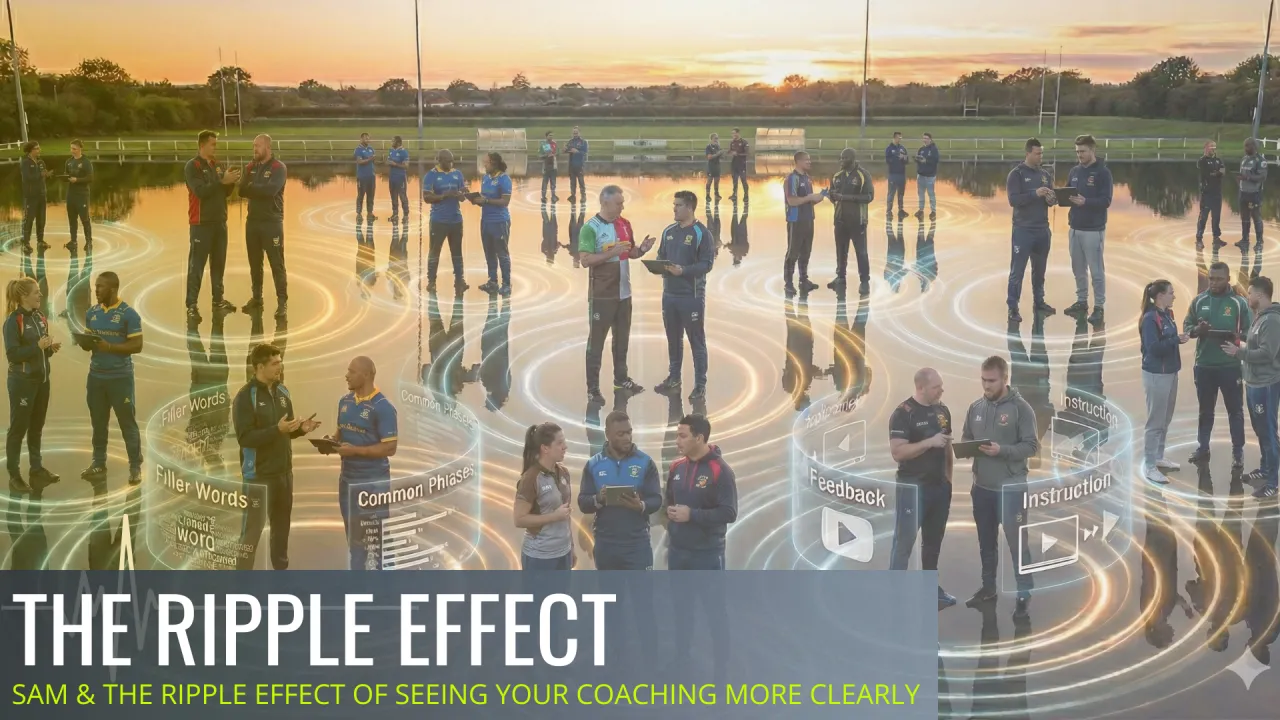
Scottish Rugby has started using SAM (Session Analysis Model) as part of the Advanced Coach Award delivery and last week I had a great coaching chat with one of my co-coaches at Currie Chieftains who has started the course. He's new(ish) to coaching but a very experienced player and already very reflective, thoughtful, and intentional about how he coaches.
He knew about SAM before his course started as he's been hearing me talk about it for months while we've been building and refining it. Even with all that, he wasn't entirely convinced SAM would reveal much about his own sessions. Not because he thought he was above feedback, quite the opposite. He just struggled to picture what SAM would pick up, how it would pick it up, and why it would matter.
Then he tried it for the first time.
And like a lot of coaches who've now used it, he found the insights surprising, not in a dramatic "your coaching is broken" way, but in the subtle, behavioural patterns that are tough to recall and reflect on.
One of the biggest things that stood out to him was his use of positive reinforcement. He's a naturally positive coach who has great energy, brilliant with people, and good at keeping tempo and momentum in a session. So it wasn't surprising that his feedback was full of positive reinforcement but what SAM reflected back was that most of his positive reinforcement consisted of quick hits of "perfect", "brilliant", "good", which are great motivational tools… but also assume the players know why that moment was successful.
When he looked at his corrective feedback, though, it was the opposite. It was packed with detail, explanations, context, the "why" and the "how". Due to his care he naturally put more thought into those moments because he didn't want Corrective Feedback to land harshly. He wanted it to be clear, actionable, and supportive.
So the conversation naturally turned into:
"we work so hard to wrap corrective feedback with meaning… but rarely take the same care with positive reinforcement."
Why don't we say: "Brilliant… because you adjusted your line early," or "Excellent… that extra option in attack created the space," or "Love that… because you solved the problem without needing me to step in."
Players don't automatically know why something was good any more than they automatically know why something needs improvement. We assume they do, because the outcome looks good. But unless we explain it, we're missing huge opportunities to reinforce the behaviours we want to see more of.
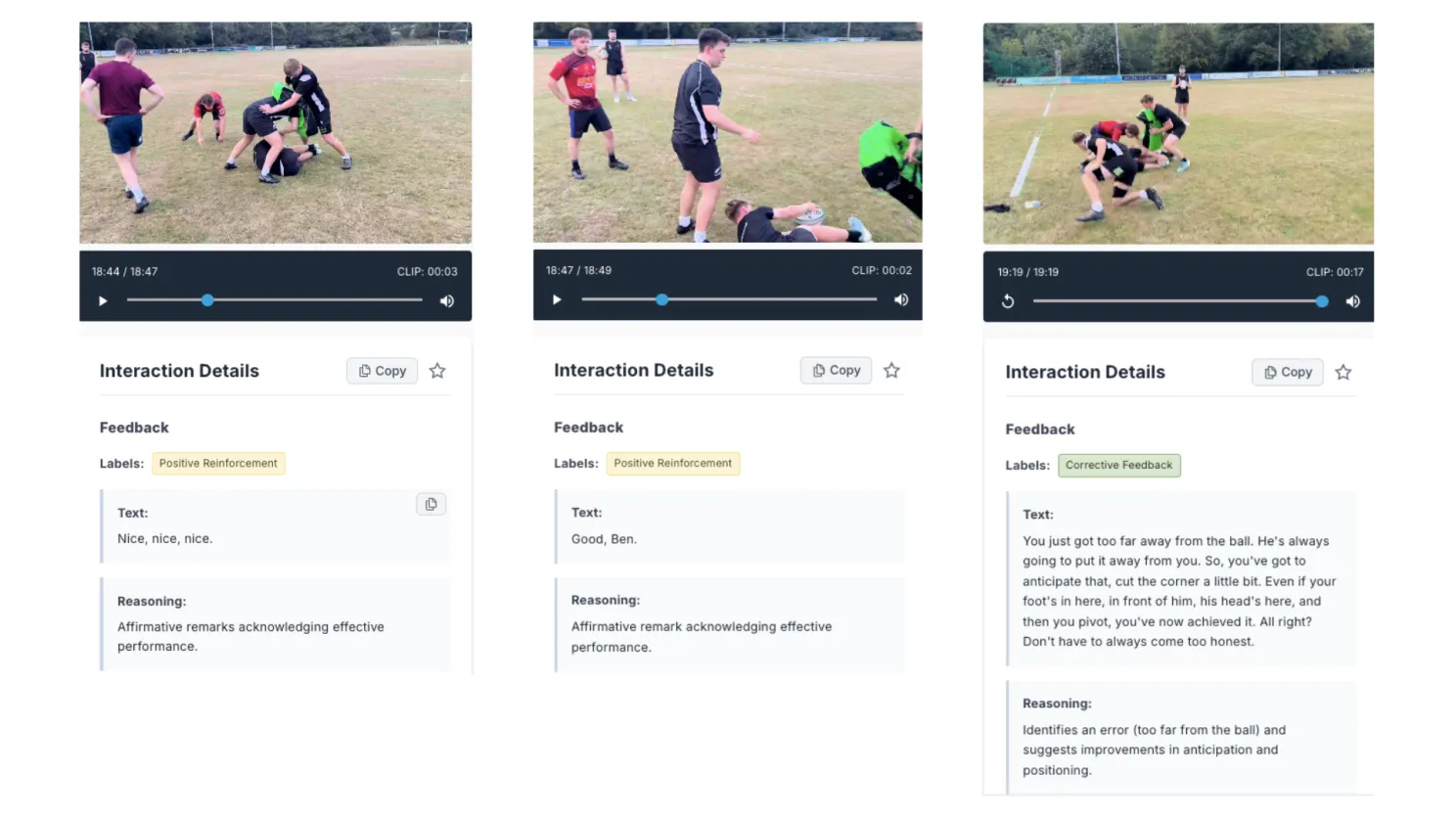
I know I am in my own SAM bubble at the moment but this is the kind of conversation SAM is starting to unlock.
And that's the ripple effect I'm most excited about.
For years, coaches have had endless game and players data like entries, exits, carries, force, acceleration, distance, tackles, breakdown events, set-piece success. We analyse the players performance to death. But we've never had equivalent data on ourselves and our delivery.
Suddenly, with SAM, coaches are getting insights into their own communication patterns:
- Their use of questioning,
- the balance between instruction and exploration,
- the type and quality of feedback they provide,
- how often they use key filler words and phrases,
- and the consistent habits they didn't know they had.
This knowledge sets up conversations on coaching delivery and governing bodies like Scottish Rugby adopting SAM is going to amplify this massively. When hundreds of coaches start seeing and reflecting on their own interactions, the volume of coaching conversations not about content or game plan, but about delivery, is going to rocket.
And that's really what we're building SAM for... not to replace the coach, or to reduce coaching to numbers, but to spark the kinds of conversations that actually make coaching human, curious, reflective, collaborative, and rooted in meaningful dialogue. It's the same philosophy we've applied for over a decade with Coach Logic; take the data, connect it to real moments, and use it to bring people together to learn and get better!
SAM is simply the next step in that journey helping coaches see themselves more clearly, talk more openly, and grow through the insights and conversations that follow.